
Why the Best Leaders Think Like Improvisers (and How You Can Too)
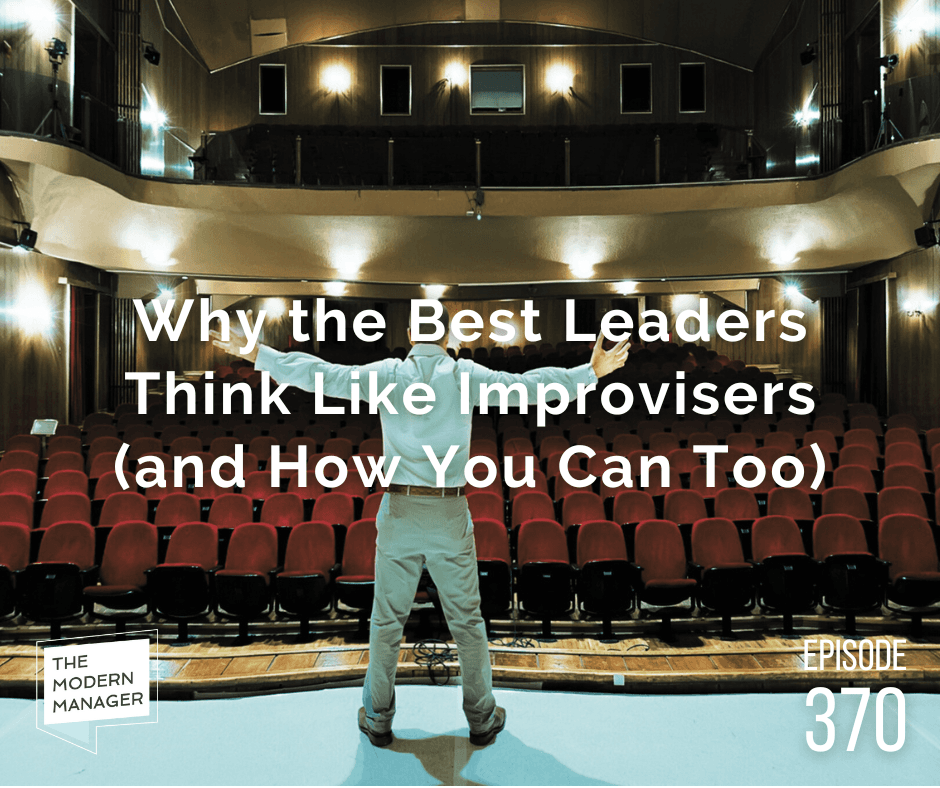
Imagine showing up to your next team meeting not with a rigid agenda, but with a mindset of curiosity, presence, and collaboration. No, this isn't about "winging it"; it's about applying the tools of improv to become a more adaptive, empathetic, and confident communicator.
While many think of improv as quirky games or scenes designed for comedy clubs, Jeff Mondoro, an improviser, learning designer, and executive coach, invites us to think differently. Jeff shared how the core principles of improv can enhance your leadership even if you never set foot on a stage.
Why Improv Isn’t Just for Performers
At its heart, improv is acting without a script. You build scenes with others in real time, with no characters prepared and no lines rehearsed. But as Jeff points out, that’s also what we do every day at work. Every meeting, every one-on-one, and every tough conversation requires some level of improvisation. We don’t always know what our teammates will say, how clients will react, or what unexpected challenge will come up.
So if we’re all already improvising, what makes intentional improv training powerful?
“It’s about building a connection,” Jeff explains. “It’s about listening, responding, and co-creating in the moment.” That’s not just a stage skill; it’s a workplace superpower.
The First Rule: Say “Yes, And” to Think Like Improvisors
One of the most well-known improv principles is the idea of “Yes, and.” It’s more than just an agreement; it’s a mindset of accepting what someone offers and building on it. In meetings, this can be transformative.
Too often, we enter discu ions with our own mental agendas. We wait for the moment to insert our thoughts, even if they’re not aligned with the flow of the conversation. The result? Disconnected dialogue and mi ed opportunities for real collaboration.
“Yes, and” reframes our approach. It asks us to actively listen, acknowledge others’ contributions, and then add value. It turns conversations from parallel monologues into a shared narrative.
Next time you're in a meeting, instead of thinking about what you’ll say next, tune in fully. Respond with something like, “That’s an interesting point. What if we also considered…” You’re not agreeing with everything blindly. You’re showing that you heard the idea and are helping move it forward.
Clarity Over Cleverne : Name the Tap Shoes
Another improv insight Jeff offers is the need to eliminate ambiguity. He gives the example of two actors dancing around a vague “present” in a scene. When no one names what the present actually is, it creates unnece ary pre ure and confusion. But once someone blurts out, “Thank you for the tap shoes!” the scene can take off in a more productive and creative direction.
The workplace equivalent? Jargon, acronyms, and vague goals. Managers often use shorthand like “Q3 priorities” or “performance alignment,” a uming everyone knows what’s being discu ed. But unle that language is unpacked, people are likely interpreting it differently or not at all.
At your next check-in, make it safe to ask, “Can we clarify what [this term or goal] means for our team?” And as a leader, model transparency by naming things clearly up front.
Perfection Is Not the Point
Perhaps one of the most powerful mindset shifts improv can offer managers is this: you don’t need to get it “right.” In fact, there may not even be a single right answer.
Jeff shares that he used to struggle with speaking in public so much so that he physically shook. But improv helped rewire his thinking. Instead of focusing on nailing the perfect line, he learned to build something collaboratively, even imperfectly. That liberated him to show up more confidently.
Perfectionism in leadership often stifles progre . We wait to share ideas until they’re fully polished. We hesitate to ask questions for fear of looking uninformed. Improv teaches us that showing up with curiosity and willingne matters more than having the “right” script.
Encourage your team to share ideas that are only 30% formed. Praise the effort of sharing, not just the result. Create psychological safety by saying, “We’re exploring here, not delivering a final product.”
You Don’t Need a Stage to Practice Improv
If you’re intrigued by the improv mindset but not ready for a spotlight, there are low-stakes ways to start practicing.
Take one improv cla . Jeff swears by it, saying he’s never met someone who regretted stepping out of their comfort zone. Improv cla es are designed to be supportive, not performative, and they’re a great way to meet new people.
Practice at home or with colleagues. Try roleplaying or “yes, and” style conversations with a friend or peer. The point is to stretch your comfort zone in low-risk spaces.
Use every meeting as a lab. Challenge yourself to listen more, speak later, and build on others’ contributions. Reflect afterward: What shifted? What surprised you?
Model risk-taking. As a manager, you’re uniquely positioned to give permi ion. If you want your team to contribute earlier or take more chances, explain why. Then support them by checking in and reinforcing that it’s okay to try (and even stumble).
Growing Without a Script
At the end of the day, leadership, like improv, is about presence, not perfection. It’s about connecting with your team, listening deeply, and co-creating something meaningful. As Jeff reminds us, “There are a hundred right ways to do something. What matters is finding the one that works for you and building on it.”
So whether you’re leading a strategic se ion, mentoring a team member, or navigating change, consider borrowing a few tools from the improv stage. You just might find that by loosening the grip on the script, you’ll lead with more clarity, confidence, and connection.
Listen to the full episode to learn more.
Listen to the full episode →
Keep up with Jeff Mondoro
Guest Bonus: Free 1-hour Workshop: Intro to Improv for members of Podcast+
In this one-hour cla , we'll explore some of the fundamental tenets of improvisation: presence, active listening with 'yes, and,' and the ability to quickly pivot and build with your scene partners. The virtual course will be highly experiential and involve a series of paired and small group exercises. We'll also debrief and discu how you might apply each principle in your work as a manager.
The workshop will be held Thursday, September 25th at 11 am Eastern (8 am Pacific, 4 pm British time)
Get this guest bonus and many other member benefits when you joinThe Modern Manager Podcast+ Community.
---------------------
The Modern Manager is a leadership podcast for rockstar managers who want to create a working environment where people thrive and great work gets done.
Follow The Modern Manager on your favorite podcast platform so you won’t mi an episode!